Why most new agents in Dubai don't last the year
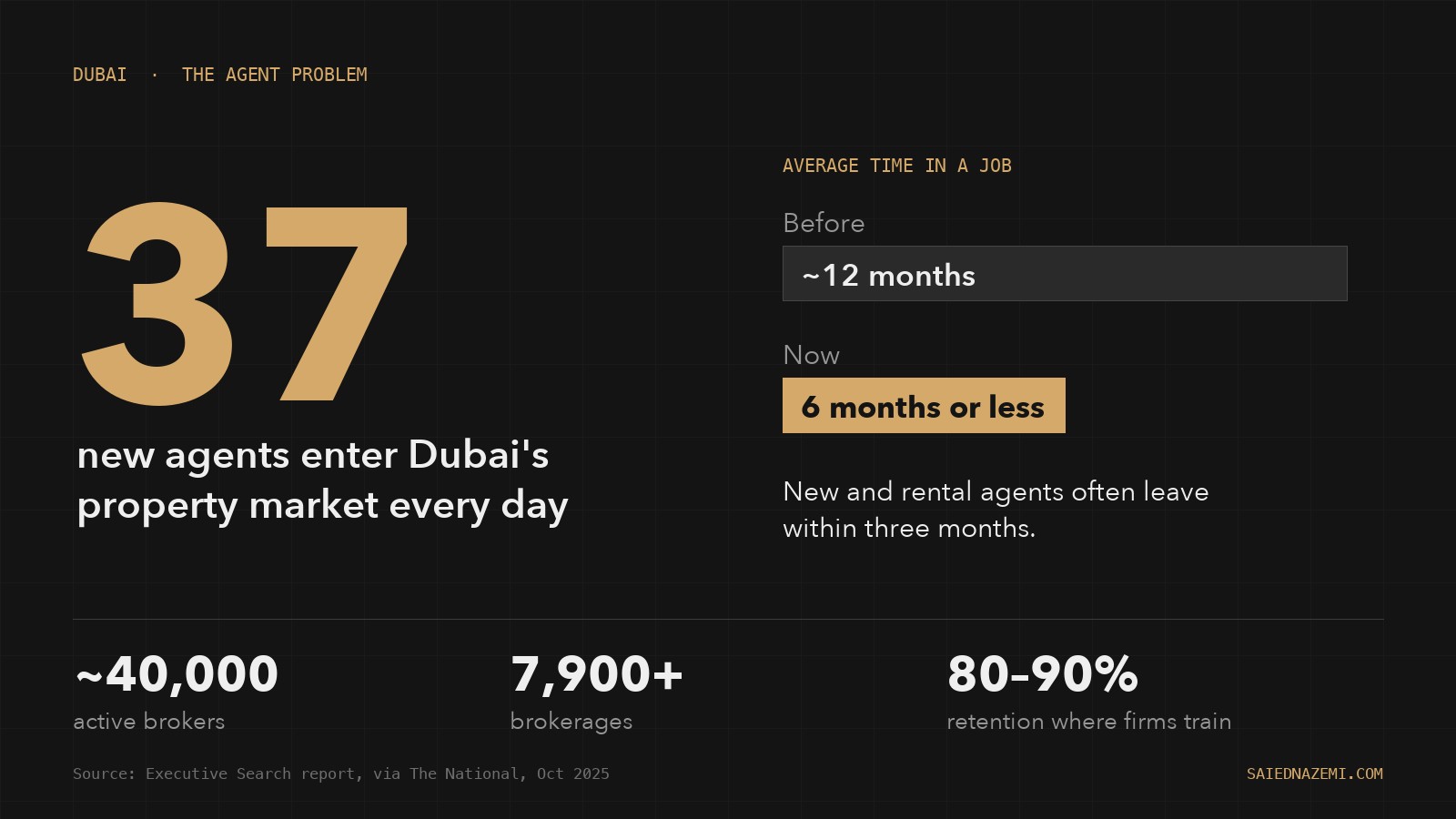
Dubai adds about 37 agents a day and loses them almost as fast. Average tenure has halved to six months or less. Most of that churn comes from two misunderstandings. New agents think uncapped income means easy income. Experienced agents think the brokerage does the hard part. It doesn't, and it never did.
I meet a lot of people who want to become agents. Most of them have already decided they're going to be good at it.
They've seen the cars and the commission screenshots. They've heard that the income is uncapped, and they believe it, which is fair, because it is. What they haven't done is think through what sits between them and that income. That gap is where most of them leave.
The numbers nobody puts in the advert
Dubai has never had more agents. An Executive Search report last October put active brokers at close to 40,000, across more than 7,900 brokerages, with roughly 37 new agents entering the market every day. Hiring was up 70% on the year.
Now the other half of that report. Average job tenure has fallen from about twelve months to six months or less. New agents and rental agents often leave within three.
Read those two numbers together. The industry is hiring at record pace and losing people at nearly the same speed. That isn't growth. It's a revolving door with a very expensive carpet.
The money looks good on paper too. The same research put average commission at around AED 18,000 a month per broker, with top performers in luxury and off-plan clearing more than a million dirhams a year. But an average in this business is a strange number. A small group of people earn a great deal and pull it up, while a lot of others earn very little, or nothing at all for months, and then disappear from the figures entirely because they've gone. Meanwhile deals per agent have been falling, because the number of agents grew faster than the number of transactions.
And that was written in a rising market. This year transaction values are running well below 2025 and prices have started to soften. I wrote about why. The cushion that used to carry weak agents through their first year has gone.
Uncapped works in both directions
Freshers tend to see becoming an agent as a stroke of luck. No ceiling on what you can earn. No boss deciding your salary. I understand why that sounds like a blessing.
Nobody tells them that no ceiling also means no floor.
The first months are the hard part, and they come before any reward. You learn the areas, the developers, the service charges, the payment plans, the difference between a building people want to live in and one people only want to sell. You make calls to people who don't want to hear from you. You do viewings that go nowhere. You spend three months on a buyer who then buys through a cousin. You close a deal and wait for the commission while the rent is due.
None of that is a secret, exactly. It just never makes it into the conversation that gets someone to sign up.
So most new agents run out of savings before their pipeline matures. They haven't failed at the job. They've failed at a plan they never made, and it's usually decided by month three, which matches the data almost exactly.
The brokerage is a platform, not a replacement for you
The second group is more surprising, because they should know better.
Some experienced agents join a brokerage believing the company will do most of the work. The leads will arrive warm. The listings will sell themselves. The brand will close the deal. When that doesn't happen, they blame the leads, then the company, and then they move to the next brokerage that promises better ones.
A real estate brokerage is a platform. A good one gives you a licence and compliance you don't have to think about, a brand people trust, listings, leads, technology, training, an office and people to learn from. That's real value, and it's why agents give the brokerage a share of their commission. Large agencies typically pay agents 40 to 50% of it, boutiques 60 to 70%.
What no platform can do is the part that actually makes the money. Calling the lead back within five minutes, not the next afternoon. Knowing the building better than the buyer does. Keeping a nervous seller on side for six weeks. Following up the eleventh time. Holding a deal together when the mortgage valuation comes in low.
A lead is not a deal. An agent who hasn't accepted that will change brokerages every six months and get the same result at each one. Some of the tenure numbers above are exactly that, the same people moving around the market looking for a company that will do the hard part for them.
What I'd tell anyone before they join this industry
Have six months of living costs saved. If you can't, start part of the way in, or wait. Desperation shows on the phone, and clients can hear it.
Treat the first ninety days as training, not earning. Learn two or three communities properly instead of skimming the whole city.
Choose a brokerage for what it will teach you, not for the split. A higher percentage of nothing is still nothing. The same report found firms that invest in training and mentorship keep 80 to 90% of their agents, which tells you where the people who stay end up.
Measure your activity before you measure your income. Calls, viewings, follow-ups. In the early months these are the only numbers you control, and they're the ones that eventually turn into commission.
What brokerages should take from this
This isn't only the agents' fault. Brokerages, mine included, have an interest in making the job sound easier than it is, because hiring is cheap and hope is free. A desk filled by someone who will leave in three months costs the agent their savings and costs the company its training time, its leads and sometimes its clients' trust.
I would rather the industry hired fewer people and told them the truth at the start. The income is uncapped. The first year is hard, the work is yours, and the company is there to make you better at it, not to do it for you.
The people who understand that before they sign tend to still be here a year later.
Sources: Executive Search report, as reported by The National, "Dubai real estate agents" (30 October 2025): active brokers approaching 40,000, more than 7,900 brokerages, about 37 new agents a day, hiring up 70% year on year, average tenure down from about 12 months to six months or less, new and rental agents often leaving within three months, average commission about AED 18,000 per broker per month, top performers above AED 1 million a year, typical commission splits, and 80–90% retention at firms investing in training and mentorship. 2026 market conditions from DLD transaction data and ValuStrat as cited in What the war did to Dubai's property market. Figures as published at the time of writing.
If you're an agent thinking about your next move, or thinking about starting, read why a quiet market is the best time to become a great agent. If you want to talk about TRPE, start here.