What the war did to Dubai's property market
The war knocked about a fifth off Dubai's listed property stocks and froze trading for roughly six weeks. The market took it back. What it didn't do was hand short-term investors the market they were hoping for. The war proved Dubai is durable. The year since has proved it isn't easy any more.
Did the war break Dubai property? I get asked some version of that every week, usually by someone who already has money here. The short answer is no. The longer answer is more useful, and it isn't the one most people want.
What actually happened
In March it stopped being something we watched on the news.
UAE air defences were firing. On 18 March alone they brought down 13 ballistic missiles and 27 drones. Debris from interceptions came down in Abu Dhabi and people were hurt. Airspace shut completely for about two hours. Emirates was flying roughly half its schedule and regional flights were down around 59%.
A lot of what has been written since has smoothed that over. I would rather not. For a few weeks nobody could tell you how this ended. Including me.
What the market did
The stock market did what stock markets do. The Dubai real estate index dropped about 20% in five sessions and gave back the entire year. Emaar fell hard. That index had run up roughly 180% since October 2023, so there was a lot of air in it to begin with.
The secondary market seized. Transaction values roughly halved month on month in the first half of March. Villa deals fell off a cliff.
And people kept buying anyway.
Between 2 and 9 March, the worst of it, Dubai registered 3,570 sales worth AED 11.93 billion. Betterhomes had enquiries running about 45% below normal, but viewings rose 75% from the first three days of the unrest to the last three. Lewis Allsopp described what he was seeing as "stability, not panic."
Then it came back, faster than almost anyone predicted. Volumes rebounded 49% in late March. April did AED 68.56 billion, up 20% on the month. Prices returned to where they had been. Mortgage activity surged. Off-plan hit its highs for the year.
The part people are getting wrong
Most of what I read now takes softening Dubai prices and calls it war damage. It isn't.
Two separate things happened this year, and mixing them up leads to bad decisions.
The war was a shock. Sharp, severe, finished in weeks. What has happened since is slower and has nothing to do with missiles. It is a market coming down off three extraordinary years.
In August the average sale price was AED 1,636 per square foot, down 1.7% on the year. First annual fall since February 2021. ValuStrat's citywide index sat 3.1% below the year before. Across the first eight months of 2026, transaction values ran 24% under 2025.
Now look at the other number. 10,900 homes still sold in August, worth AED 23.4 billion.
That is not distress. That is the flippers leaving and the owners staying.
If you arrived in 2023 expecting 20% a year forever, this reads as failure. I think it is the opposite. A market that only goes up has not been tested, and untested markets are where people get hurt. Dubai took a direct military shock and a price correction in the same year and still clears more than ten thousand homes a month. The downside case got measured in public. I would take that over another year of easy money.
Why the UAE held
This was not luck.
The UAE said where it stood early and did not move. The Ministry of Foreign Affairs stated it would not allow its airspace, territory or waters to be used for military action against Iran, and gave no logistical support. It kept talking to every side and pushed publicly for de-escalation.
Behind the diplomacy was hardware that worked. Airspace closed for two hours, not two weeks. Banks opened. The Land Department kept registering. Schools went back. Flights resumed.
If you own something here, that is the whole case. Stay out of the fight, defend the ground, keep the institutions running. Nobody advertised it. They just did it, in front of everyone.
None of which means you can buy anything
The market held. Individual locations did not.
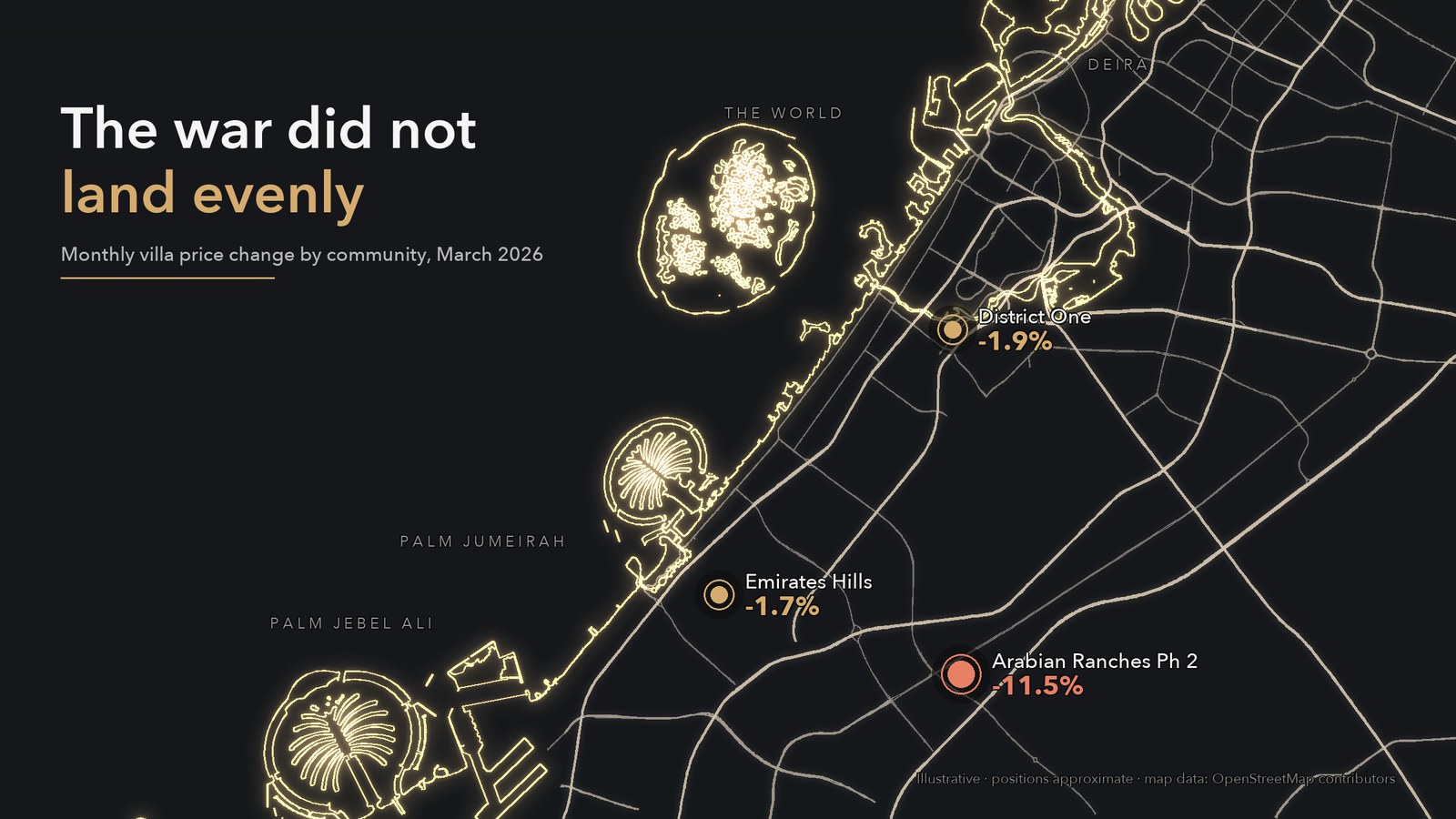
Arabian Ranches Phase 2 villas fell 11.5% in a single month, the steepest villa drop recorded in the city. Emirates Hills moved 1.7%. District One 1.9%. Same war, same month, same city.
Pressure does not spread evenly. It finds thin demand and speculative ownership, and it finds them fast.
One Arabian Ranches villa cut its asking price five separate times through the spring, from AED 8.5 million down to 7.4 million, about 13%. It still did not sell. Citywide, physical prices came off roughly 4-7% from the February peak, while motivated sellers were doing 15-30% in individual deals.
Averages hide that. You buy one property, not an index.
Citi's bear case still models average declines of around 7% a year through 2028 if the region stays unstable. In a market this split, an average tells you very little. Some locations will beat it comfortably. Others will do a great deal worse.
Three things I would actually do
Underwrite on the rent. If the numbers only work on a sale in eighteen months, you are not investing. You are betting on the next buyer, and that bet has stopped paying.
Check the handover pipeline before you read the brochure. Heavy 2026-2027 completions with no end-user demand underneath is where the next correction lands. Almost nobody does this, and it takes ten minutes.
Pay for scarcity. Waterfront, genuine prime, constrained plots, developers who actually finish. They held through the worst month this market has ever had. You just watched that premium get earned.
Dubai is in better shape than it was two years ago. Better priced, less frothy, and we now know what it does under real pressure.
It just doesn't forgive lazy buying any more. If you are waiting for the easy version to come back, I don't think it is.
Sources: UAE Ministry of Foreign Affairs statement on non-use of airspace and territory; CNBC and Euronews reporting on the March 2026 airspace closure and air defence interceptions; The National, "Stability, not panic" (10 March 2026), for the 3,570 sales / AED 11.93bn and Betterhomes enquiry and viewing figures; Gulf Business for the 49% late-March rebound; April transaction total AED 68.56bn; Arabian Business and ValuStrat Price Index for August 2026 pricing (AED 1,636 psf, −1.7% YoY, VPI −3.1% YoY) and the ~10,900 August sales / AED 23.4bn; Citi bear-case projections through 2028; AGBI reporting on seller price reductions. Community-level monthly moves are as reported by Dubai brokerages and should be read as indicative of the pattern rather than as an index. Figures as published at the time of writing.
If you want the location-by-location version of this rather than the market-wide one, that is the conversation I have with clients every week. Start here, or read my fuller UAE market report.